
Wastewater Treatment Project
Frequently Asked Questions (FAQs)
Frequently Asked Questions (FAQs) will be regularly updated below.
Overall
- The Village of Daajing Giids is getting a new wastewater treatment plant.
- The new plant will be the largest project in our community for years to come – it’s a big deal!
- We are one of the last remaining communities to pump raw sewage into the ocean. This project is an exciting opportunity to better protect our environment and island home.
- The new plant will help keep the environment healthy and support our community.
- Every drop of wastewater that goes through our pipes to the ocean must be treated – this is a requirement of the Ministry of Health and Ministry of Environment.
- Almost half a million litres of raw sewage is discharged into Bearskin Bay every day.
- Raw sewage can harm the places that make our community special - our shorelines, our beaches and our ocean. It can have effects on shellfish, fish and other ocean creatures that are important parts of our economy, our culture and our heritage.
- The new plant will ensure wastewater is treated before it makes it into the ocean, meaning less harm to our environment, and safer water for us all to enjoy.
- There are a lot of places where the new wastewater treatment plant could go.
- It is too early to say where the wastewater treatment plant will go. The site and treatment selection process will take at least six months (maybe 18 months) to complete.
- There are also a lot of things the project team needs to think about when deciding the best place - things like site size, road access, environmental and soil conditions and more.
- A lot of people and organizations are interested in the wastewater treatment plant project. The project team will consider these interests as well as their technical work when choosing a location for the new wastewater treatment plant.
- The Province has made a $20 million investment in our community. Daajing Giids received government grants to cover the cost of planning and building a new wastewater treatment plant which is a good start for us. This funding includes $1.3 million from the Investing in Canada Infrastructure Fund.
- Efforts will be made to find a solution that is affordable for the community based on the grant funding available.
- Once built, the cost of running the wastewater treatment plant will be our responsibility.
- We all benefit from treating our raw sewage and will share the cost of maintaining our new system through user fees.
- It is too early to say what the user fees may be. The cost of running and maintaining the plant will depend on the site and treatment process selected.
- This community investment is essential for our long-term health and well-being.
- Once built, the cost of running the wastewater treatment plant will be our responsibility.
- We all benefit from treating our raw sewage and will share the cost of maintaining our new system through user fees.
- The new wastewater treatment plant is an exciting opportunity to better protect our environment and island home. This project will make our ocean cleaner, our beaches safer and our environment healthier.
- This project will allow us to plan better for our future and manage growth and development wisely.
- This will be a big construction project that could take more than a year to complete once started.
· Check
the Village webpage and look for newsletters in your mail. The Village will
keep you updated on the project as it progresses.
· If
you have any questions, you can send them to office@daajinggiids.ca and the Village will do their best to answer. This FAQ page will also
be updated regularly.
· Wastewater
Treatment is also a standing item at Council meetings (item 17.1). Meetings are
open to the public, so you can attend in person or via Zoom. Check www.daajinggiids.ca/council-meetings for details.
Proximity to Existing Residences
Impact on Existing Residences
The Skidegate plant is a great example of one technical solution that is being explored for the in-town locations. We understand residents do not complain about the smell of the plant. The wastewater treatment lagoons in the Village of Old Massett are about 200m from the closest homes. The lagoons use a similar process to treat wastewater.
Skidegate Connection
Access to private driveways will be maintained, however may be temporarily disrupted at times. The Village of Daajing Giids would work closely with the construction contractor, Ministry of Transportation and Transit, and affected property owners and businesses to ensure impacts are minimized and emergency services, ferry access and other important services are maintained.
It is important to note that highway travel would also be impacted should two (2) of the in-town options be selected as the preferred site.
The length of the forcemain and its location along the highway could make it more vulnerable to disruption from pipe failures, seismic events, or highway washouts. These events are rare and the Village of Daajing Giids would have standard operating procedures and emergency response plans in place to manage these events should they occur.
Sewer and Septic Servicing
The water and wastewater servicing strategy project, separate from the wastewater treatment project, is exploring ways residents and businesses across the community could connect into the sewer system regardless of where the wastewater treatment plant is located. The servicing options being considered include:
1. A low-pressure sewer system. This would include a common municipal forcemain and all residents and businesses would own and maintain private lift stations to discharge their wastewater into the municipal forcemain.
2. Gravity collection systems to convey wastewater from private properties to community municipal lift stations, like our current system. This option would not require private lift stations.
The Village of Daajing Giids is also drafting plans and designs to remove the treatment residuals from the existing drinking water treatment plant from the sewer system to the extent practical, which will reduce the wastewater volumes the new facility needs to manage.
Order of Magnitude (O&M) Cost Estimates
At this stage, the costs are presented with the following:
- A contingency to account for unknowns that may be required as part of the project but are not yet fully defined (such as variable ground conditions). This contingency is part of the base capital cost estimate and is included for all options.
- Costs are presented in a range to show what the low and high costs are projected to be based on the information available. Currently a range of plus or minus 50% has been used on the base capital cost estimate.
The cost estimates will be refined through the detailed design phase. The detailed design phase will also help the engineers identify and mitigate potential risks that could impact the project schedule and budget.
Operating and maintenance costs for the plant would be paid for by users, however these costs would be relative to the actual flows conveyed in the plant, and not the maximum design capacity. For example, power consumption and pump maintenance conveying and treating the wastewater would be based on the actual number of users which will change over time.
The plant will be designed to meet our changing capacity requirements over time.
The table presents two (2) scenarios that include borrowing costs and one without borrowing. The estimated annual fee of $883 includes the cost of borrowing $3 million from the Province while the estimated annual fee of $1,282 includes the cost of borrowing $6.5 million. The borrowing costs for both scenarios are shown in orange.
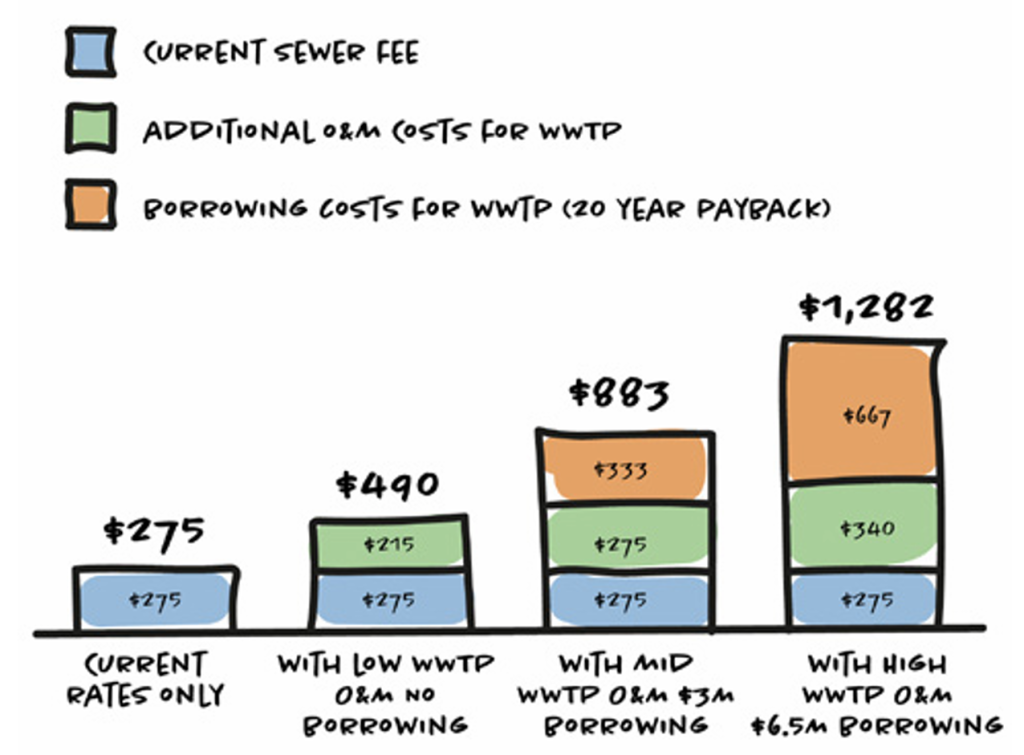
The rates shown are for residential users only (people already connected to the sewer system). The user fees will be different for commercial and industrial users.
Outfall
The design phase will confirm if the existing outfall may be able to remain (and be used in emergency situations) rather than be removed.
Once a site is selected, an Environmental Impact Study (EIS) will be completed. This study will go through more regulatory review and assessment of the potential impact on the ecosystem and human health. Rules also require monitoring before and after discharge to help protect the marine environment.
The treated wastewater could have a minor effect on salinity in the water close to the outfall. A mixing area will be created around the discharge point where the treated wastewater blends with ocean water. Water quality rules must be met at the edge of this area. The size of the mixing area will be confirmed through modelling and design in the next phase.
Other
Have a Question?
Check out the Frequently Asked Questions (FAQ) on this page, or send your question to office@daajinggiids.ca. The Village will work with Urban Systems to answer all your questions.
Want to Learn More?